
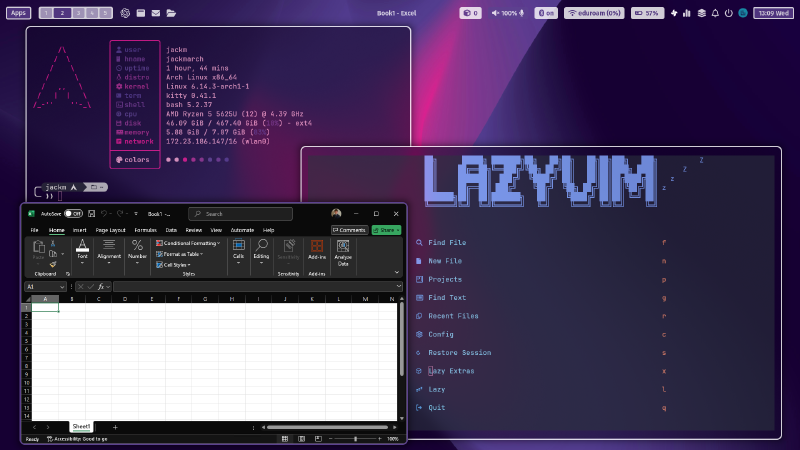
I switched to Linux a year ago, searching for freedom from “Microslop’s” hypothetical chains. For much of that time, my Linux setup revolved around customisation, and simply looking cool. For the first 12 months, I used Arch Linux. I experimented with tiling window managers (settling on Hyprland), spent hours tweaking dotfiles, and constantly chased the perfect desktop experience. Like many Linux enthusiasts, I fell into the culture of ricing – endlessly modifying every visual detail of my system in pursuit of something uniquely mine. At first, it was exciting, Hyprland felt like a new philosophy of computing. I spent a lot of time building out a heavily customised setup with fancy dotfiles, animations, and carefully tuned workflows. My terminal (kitty) was customized, my status bar was handcrafted, I had a containerised windows installation for MS-Office, and my desktop screenshots looked impressive (Figure 1).
But eventually, I started asking myself an uncomfortable question: Was any of this actually improving my computing experience?
Over time, the answer became increasingly clear: not really.
Arch Linux is fantastic for people who enjoy building their system from the ground up, and I learnt many lessons on how UNIX-like operating systems function under the hood. The documentation is excellent, the community is passionate, and the level of control is unmatched. But that freedom comes with a hidden cost. The more customizable your environment becomes, the easier it is to spend more time maintaining your system than actually using it.
I would regularly:
- Rewrite configuration files for tiny visual improvements
- Replace working tools simply because something newer appeared on the Arch User Repositories
- Spend hours fixing issues caused by experimental software
- Constantly rebuild my desktop after reinstallations or major changes
- Obsess over aesthetics instead of productivity
There is a strange culture in parts of the Linux community where complexity itself becomes a badge of honour. The more obscure your setup, the more impressive it appears, and while there is absolutely nothing wrong with customization as a hobby, I eventually realized I no longer enjoyed treating my operating system like a permanent side project – I have work that needs to be done and I merely want my computer to work. Thankfully, after months of gradual instability and bloat, a dependency error completely borked my Hyprland setup and gave me an excuse to start over. It is important to note that this was likely due to my extensive use of the AUR, and not a fault of the devs, who do a great job!
I did not suddenly start disliking Arch Linux. In fact, I still think it is one of the best Linux distributions for learning how Linux works internally. Arch taught me more about Linux than any other operating system ever could (except perhaps Gentoo – I am, alas, not a masochist). But eventually I reached a point where I valued stability, convenience, and reliability more than endless customization. That is what led me to openSUSE Tumbleweed.
At first glance, Tumbleweed seemed unusual compared to other rolling-release distributions. It is still cutting-edge, but it approaches updates far more cautiously than Arch. One of the biggest differences is the testing process. Packages in Tumbleweed go through extensive automated testing before reaching users. This significantly reduces the chances of system-breaking updates while still keeping software relatively current. The result is a rolling-release distribution that feels surprisingly stable.
Some features that immediately stood out to me were:
- Reliable snapshot and rollback functionality through Snapper and Btrfs
- Sensible defaults that required minimal tweaking
- A polished KDE Plasma experience out of the box
- Strong integration tools like YaST that aid with backend sysadmin jobs which I admittedly still tinker with.
- Better system resilience during updates
- Exceptional dependency management through the Zypper package manager.
The biggest surprise in this journey was not actually changing distributions. It was abandoning tiling window managers.
For a long time, I convinced myself that using a tiling WM made me more productive. Keyboard-driven workflows felt efficient, and highly minimal desktops looked elegant. And to be fair, tiling window managers can genuinely improve workflows for some people. But eventually I realized that I was forcing myself into a workflow that no longer matched how I actually used my computer. KDE Plasma in particular surprised me with how customizable, lightweight, and polished it has become. I could still use keyboard shortcuts, virtual desktops, and advanced workflows - but without spending hours configuring basic functionality.
Simple things became easier:
- Bluetooth worked reliably
- Audio devices switched properly
- Multi-monitor support required no manual configuration in a random dotfile that changes location every other update.
- Power management behaved correctly – including power profiles and wake on LAN.
- Applications integrated more naturally, with the QT framework being standard across all essential apps.
- Wayland support felt more mature as opposed to the still in development Hyprland.
Most importantly, I stopped thinking about my desktop environment all the time. That might sound strange, but I think it is actually a sign of good software.
One thing I have noticed in Linux spaces is that there can sometimes be subtle pressure to pursue increasingly complex setups. Minimalism becomes performative, with people competing over terminal workflows, startup times, memory usage, or how little software they rely on (systemd haters will never stop getting on my nerves – just use it, it works). Again, there is nothing inherently wrong with any of this, experimentation is part of what makes Linux fun, but I think many users – especially newer users – can end up believing that they should constantly optimize and customize everything in order to be a “real” Linux user. You do not. Using a polished desktop environment does not make you less technical. Choosing convenience does not make you lazy. And preferring stability over endless tinkering does not mean you have somehow “lost” your enthusiasm for Linux.
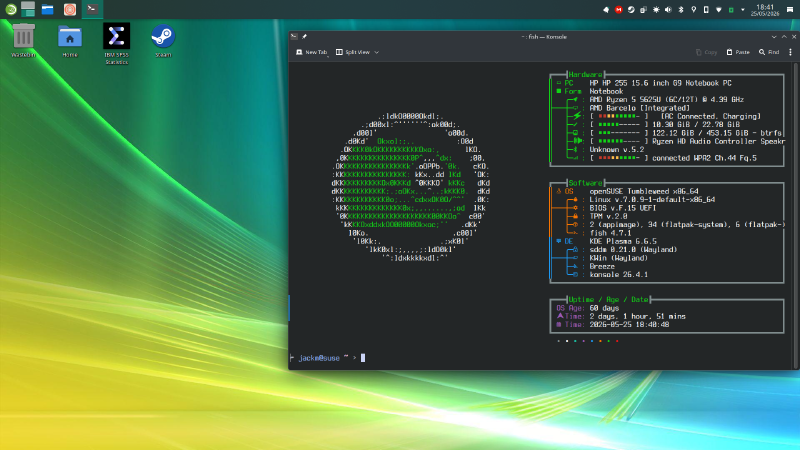
In many ways, I think I appreciate Linux more now than I did before. I no longer feel the need to prove anything through my setup (Figure 2).
One of the most important things I learned from this transition is that simplicity is not the same as limitation – and that it is often underrated. A simpler setup often means:
- Less maintenance
- Fewer distractions
- More reliability
- Better focus
- More time spent actually doing meaningful work
I still enjoy Linux customization and I still appreciate tiling window managers for what they are and how they solve the problems that exist with classical floating WMs.
I still think Arch Linux is excellent, but my priorities changed. Today, I value comfort and consistency more than endless tweaking. My desktop no longer exists to impress people online, it instead exists to help me work, study, write, browse, and enjoy using my computer. And honestly, that feels far more satisfying.
Switching from Arch Linux to openSUSE Tumbleweed was less about changing distributions and more about changing my relationship with technology. I stopped viewing my operating system as a project that always needed improvement. I stopped chasing the “perfect” setup. And somewhere along the way, I rediscovered something I had slowly lost, that being the simple enjoyment of using my computer without constantly needing to fix, tweak, or reinvent it.
Ironically, after years spent searching for the ultimate Linux setup, I ended up appreciating something much simpler.
And, whether that is a sign of me getting old, or a sign of me maturing, I think that is perfectly okay.